Bidirectional Normalizing Flow: From Data to Noise and Back
Authors: Y. Lu*, Q. Sun*, X. Wang*, Z. Jiang, H. Zhao, K. He
Status: Submitted to CVPR 2026.
Preprint: arXiv: 2512.10953
Overview
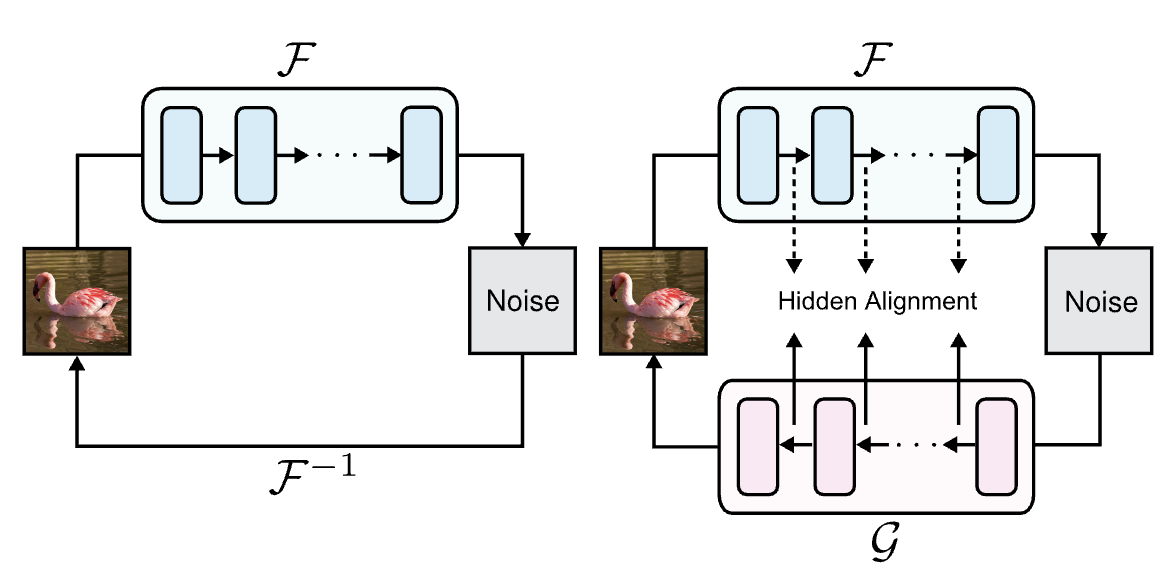
This paper introduces BiFlow, a generative framework designed to overcome the architectural constraints of standard Normalizing Flows (NFs) by removing the requirement for an exact analytic inverse. Unlike traditional NFs that mandate a strictly invertible forward process (limiting them to causal architectures), BiFlow decouples the forward and reverse processes: it uses a forward model to map data to noise and trains a separate, learned reverse model to approximate the inverse mapping via a novel “hidden alignment” objective. This separation enables the reverse model to leverage powerful non-causal architectures, such as Vision Transformers, and flexible loss functions like perceptual loss, which were previously inaccessible to standard flows. As a result, BiFlow achieves state-of-the-art image generation quality among NF-based methods on ImageNet and accelerates sampling by up to two orders of magnitude compared to autoregressive baselines, enabling high-quality generation in a single forward pass (1-NFE).